
What Is NIST CSF? A Plain-English Guide for Business Leaders
If you have heard vendors, insurers, or partners mention the NIST CSF and wondered what it actually means for your organization, you are not alone. What is NIST CSF? In plain terms, it is a practical roadmap for managing cybersecurity risk-not a product you buy, and not a law that automatically applies to every small business.
This guide explains the NIST Cybersecurity Framework in business language so owners, executive directors, and board members can decide whether it belongs in their security plan.
What is NIST CSF?
The NIST Cybersecurity Framework (CSF) is a voluntary set of guidance published by the U.S. National Institute of Standards and Technology. It helps organizations of any size describe, assess, and improve how they manage cyber risk.
Think of it as a shared language. Instead of arguing about random tools or checklists, leadership can ask: How well do we understand our risks? How do we protect critical systems? How quickly can we detect and recover from an incident?
NIST released an updated version commonly called CSF 2.0. The core idea stays the same: organize security work into clear functions your leadership team can discuss without needing a room full of engineers.
You can review NIST's official overview on the NIST Cybersecurity Framework site.
Why the NIST Cybersecurity Framework matters to SMBs and nonprofits
Large enterprises often have full security teams. Small and mid-sized businesses and nonprofits usually do not. That is exactly why a simple structure helps.
- Customer and partner questionnaires often map to framework language (identify assets, protect data, detect incidents).
- Cyber insurance applications ask about controls that align with CSF-style practices.
- Boards and funders want evidence you are managing risk deliberately-not hoping nothing bad happens.
- Budget decisions get clearer when gaps are grouped by function instead of a pile of vendor pitches.
You do not need to "certify to NIST CSF" to benefit. Many organizations use it as a lens for prioritization-the same way a good risk assessment produces a score and a roadmap.
The core structure of NIST CSF (in plain English)
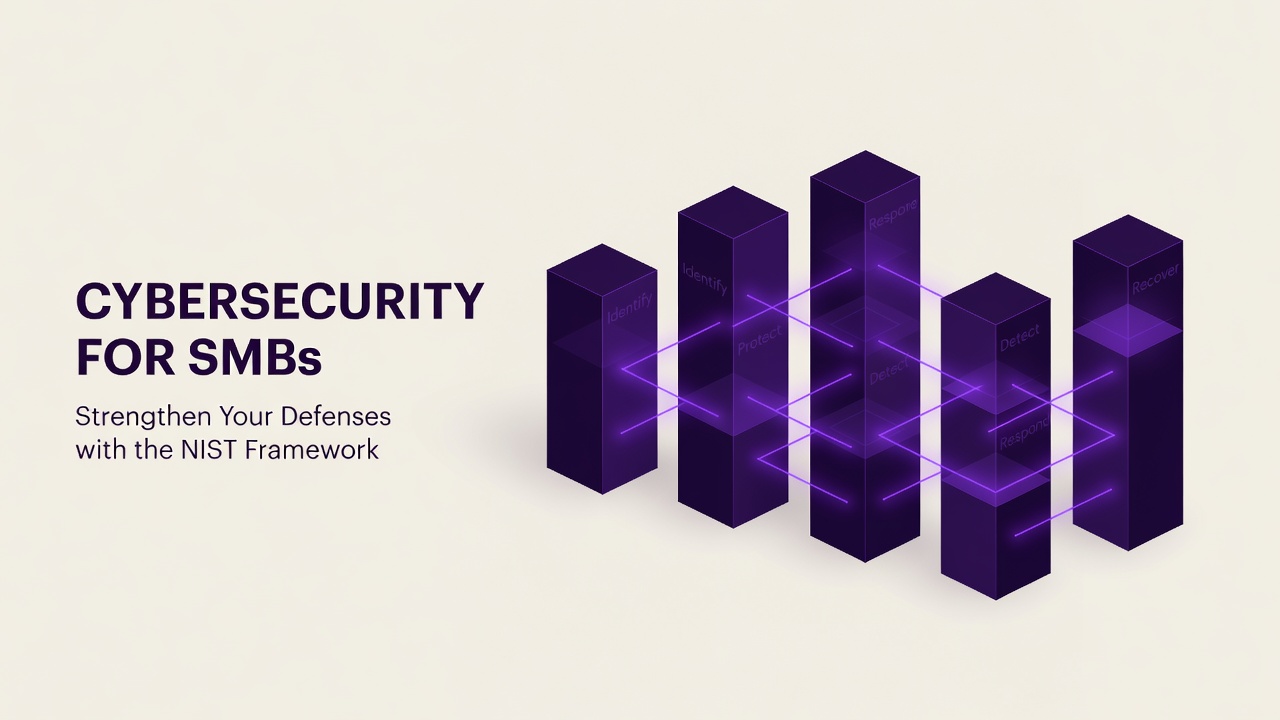
CSF organizes cybersecurity into high-level functions. CSF 2.0 is commonly described with six:
- Govern - Leadership, roles, policies, and risk decisions. Who owns security outcomes?
- Identify - Know your critical systems, data, vendors, and risks.
- Protect - Safeguards such as access control, backups, training, and secure configurations.
- Detect - Spot unusual activity or failures before they become disasters.
- Respond - What you do when something goes wrong (roles, communication, containment).
- Recover - Restore operations and learn so the next incident is less painful.
Under those functions sit categories and outcomes. For an SMB, you do not start by boiling the ocean. You start by asking which functions are weak relative to your real risks-ransomware, email compromise, lost laptops, third-party vendors, or donor data exposure.
What NIST CSF is not
- Not a product. No single software package "is" the NIST CSF.
- Not only for federal agencies. Private companies and nonprofits use it widely as best practice.
- Not a substitute for leadership. A framework on a shelf does nothing without owners, priorities, and follow-through.
- Not the same as a full compliance program. Some industries need specific regulations (HIPAA, PCI, CMMC, and others). CSF can support those efforts, but it is not a magic checkbox for every rule set.
How to use NIST CSF without getting lost
1. Start with outcomes, not jargon
Ask leadership: What would hurt us most if it failed-email, payments, donor systems, customer data? That drives Identify and Protect work first.
2. Pair the framework with a real assessment
A lightweight cybersecurity risk assessment against CSF-style outcomes gives you a baseline. You learn where you are strong, where you are exposed, and what "good enough" looks like for your size.
3. Build a short roadmap
Turn findings into 90-day and 12-month priorities. Frameworks fail when everything is "high priority."
4. Assign owners
IT or your MSP can run tools. Someone still needs to own risk decisions, board reporting, and insurance questions. That is often where fractional cybersecurity leadership (a vCISO model) fits.
5. Revisit on a cadence
Threats and vendors change. Review the baseline at least annually-or after a major system change, merger, or insurance renewal.
Key takeaways
- What is NIST CSF? A voluntary cybersecurity risk framework from NIST that organizes security into clear business-facing functions.
- It is useful for SMBs and nonprofits as a shared language for risk, insurance, and board conversations-not only for large enterprises.
- CSF 2.0 emphasizes governance: leadership accountability sits at the center.
- Value comes from assessment, prioritization, and ownership-not from buying a logo-labeled tool.
- Pair the framework with a practical roadmap so progress is measurable.
How Executive Solutions can help
At Executive Solutions, we help SMBs and nonprofits turn frameworks like the NIST Cybersecurity Framework into decisions leaders can fund and track. Engagements typically start with a baseline assessment that produces a clear risk picture and prioritized roadmap. From there, fractional / vCISO leadership keeps the plan moving-working with your MSP or internal IT so strategy and operations stay aligned.
Ready to see where you stand? Schedule a free discovery call and we will help you connect NIST CSF concepts to a practical next step for your organization.